Table of Contents
- Crimson Legal: Your Strategic Partner
- Structural Analysis of Jurisdictions: Mainland vis-à-vis Free Zones
- Legislative Transformations in the Mainland
- The Regulatory Environment of Independent Financial Centres (ADGM and DIFC)
- Strategic Positioning and Institutional Methodology of Crimson Legal
- Legal Services Infrastructure: The Six Pillars of the Corporate Life Cycle
- Sectoral Scope and Empirical Analysis of Client Outcomes
- Intellectual Capital and Distinguished Legal Leadership
- Advanced Jurisprudential Contributions and Thought Leadership
- Conclusions and Strategic Recommendations
- Frequently Asked Questions (FAQ)
- References
“The paramount foundational strategic decision for any nascent commercial venture in the State lies in determining the company’s legal domicile—a decision bearing long-term tax, operational, and statutory implications.”
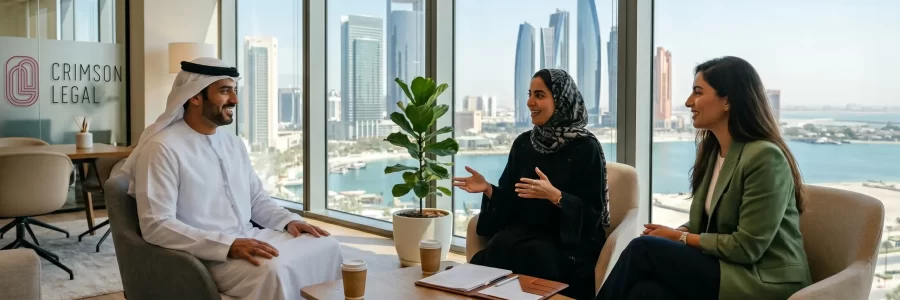
Within this highly competitive context and pluralistic legal paradigm, the role of specialised legal consultancies has emerged as crucial structural architects for the success of modern commercial ventures. This comprehensive investigative examination explores the corporate legal model in the UAE through an operational and strategic lens, focusing specifically on Crimson Legal, a leading boutique legal consultancy headquartered in Abu Dhabi. Since its incorporation in 2022, the firm has carved out a distinguished niche within the legal services sector by adopting a progressive, founder-centric approach.
Crimson Legal has eschewed traditional methodologies predicated on legal intimidation in favour of providing empowering strategic counsel grounded in education and a holistic understanding of the corporate life cycle’s exigencies. Through a detailed analysis of the firm’s service infrastructure, client outcomes, intellectual capital, and its responses to recent statutory reforms, this report elucidates the fundamental legal mechanisms requisite for achieving sustainable corporate growth, regulatory compliance, and risk mitigation in the broader Middle East and North Africa (MENA) region.
Structural Analysis of Jurisdictions: Mainland vis-à-vis Free Zones
To fully apprehend the strategic value of bespoke legal counsel in the UAE, one must first deconstruct the fundamental structural complexities characterising this jurisdiction. The commercial landscape is bifurcated primarily into “Mainland” entities subject to federal commercial law, and “Free Zone” entities operating under independent regulatory frameworks tailored expressly to attract and incubate foreign capital.
Making the wrong jurisdictional choice at the onset of business formation can lead to significant operational bottlenecks, higher taxation, and severe restrictions on the ability to trade directly with the local market. For this reason, comprehensive legal structuring is the first critical line of defense for emerging enterprises.
Legislative Transformations in the Mainland
Mainland entities afford expansive commercial capabilities, encompassing unrestricted trading within the domestic market, direct access to lucrative governmental tenders, and significant flexibility for service providers operating across the UAE. Historically, these entities mandated that a UAE national hold a minimum of 51% of the company’s share capital, an aspect that heavily dictated foreign investment strategies.
However, Federal Decree-Law No. 32 of 2021 on Commercial Companies precipitated a veritable legislative revolution by abrogating this mandatory prerequisite for the majority of commercial activities on the Mainland. This pivotal shift has reconfigured the foreign investment landscape, permitting foreign investors to hold 100% legal ownership of their enterprises across a substantially broader spectrum of sectors, thereby democratizing access to the UAE’s robust domestic economy. For ongoing updates on commercial laws, businesses often refer to the UAE Government Business Portal.
Nevertheless, this liberalisation of ownership requirements has been accompanied by a palpable augmentation in regulatory compliance burdens. Mainland entities are now obliged to adhere to much more stringent governance stipulations, including:
- Mandatory annual financial audits to ensure fiscal transparency.
- Precise registration and continuous updating of Ultimate Beneficial Owners (UBO) to combat illicit financial flows.
- The implementation of rigorous Anti-Money Laundering (AML) procedures in alignment with international financial standards.
Legal experts submit that failure to comply with these updated statutory requirements may result in exorbitant pecuniary penalties or the immediate revocation of commercial licences, thereby rendering the retention of legal counsel well-versed in these changes absolutely indispensable.
The Regulatory Environment of Independent Financial Centres (ADGM and DIFC)
Adding a further layer of complexity to this business landscape is the presence of independent financial centres operating under common law systems, most notably the Abu Dhabi Global Market (ADGM) and the Dubai International Financial Centre (DIFC). In contra-distinction to the remainder of the UAE, which relies on civil law systems derived from Latin and Egyptian schools of jurisprudence, these advanced centres operate pursuant to the principles of English Common Law.
Specifically, the regulatory framework of the ADGM applies English Common Law directly within its jurisdiction, rendering English judicial precedents directly enforceable within the Market. This principle was unequivocally affirmed in a landmark judgment handed down by the ADGM Court of Appeal in the matter of AC Network Holding Ltd v Polymath Ekar SPV1, which entrenched the direct application of English legal precedents as a cornerstone of the Market’s legal system. Access to such robust judicial frameworks is further detailed by the Abu Dhabi Global Market Authority.
This direct integration with English law confers upon international investors, venture capital funds, and entrepreneurs an unparalleled degree of legal certainty and regulatory familiarity, thereby mitigating cross-border investment risks. Furthermore, entities incorporated within the ADGM benefit from pioneering strategic agreements, such as the dual-licensing framework with the Abu Dhabi Department of Economic Development (ADDED), which permits qualifying entities to provide services to clients in the Abu Dhabi Mainland without the necessity of establishing an additional physical presence outside Al Maryah Island.
Comparative Analysis: ADGM vs. Abu Dhabi Mainland
The following points delineate the distinct characteristics between the two primary legal structures:
- Legal Framework and Judicial System: ADGM utilizes the direct application of English Common Law, whereas the Abu Dhabi Mainland operates under UAE Civil and Commercial Law (Federal Decree-Law No. 32 of 2021).
- Foreign Ownership Ceiling: ADGM permits 100% foreign ownership for all activities without exception. The Mainland permits 100% ownership for most activities, subject strictly to ADDED approval based on the specific commercial activity.
- Market Access Scope: ADGM offers global access, access to other Free Zones, and Mainland access via the dual licensing mechanism. Mainland entities enjoy inherently unrestricted access throughout the UAE and international markets.
- Corporate Tax Dynamics: ADGM entities typically enjoy 0% corporate tax within the financial centre’s scope (subject to federal tax if operations extend beyond), while Mainland entities are subject to a 9% corporate tax on net profits exceeding AED 375,000.
- Physical Infrastructure Requirements: ADGM mandates the lease or acquisition of physical office space strictly within the Market’s geographical boundaries. Mainland registration requires the mandatory provision of commercial or office space anywhere within the Emirate of Abu Dhabi.
- Visa Quotas: ADGM visa quotas are relatively restricted and typically linked proportionally to the square footage of the leased office space (usually 1 to 3 visas). Mainland visa quotas are much more flexible and directly proportioned to the size of the leased commercial premises.
This comparative analysis demonstrates that the selection of a jurisdiction is not a mere administrative formality, but rather a fundamental, core strategy that dictates the company’s entire financial and operational trajectory. The rapid proliferation of incorporation options necessitates meticulous legal engineering to ensure founders do not fall foul of hidden costs or unforeseen operational encumbrances.
Strategic Positioning and Institutional Methodology of Crimson Legal
Within this labyrinthine regulatory landscape, Crimson Legal is strategically positioned at the intersection of technological innovation and commercial ambition. Founded in 2022 and headquartered on the 15th floor of Al Sarab Tower within the ADGM on Al Maryah Island, the firm is classified as a premium Boutique Legal Consultancy. It comprises a cohesive, highly specialized team of nine legal professionals possessing profound expertise in advising startups, SMEs, and venture capital entities.
Operational Philosophy: Counsel Grounded in Empowerment and Empathy
Crimson Legal’s analytical approach is distinguished by its express rejection of the traditional “fear-based” paradigms frequently deployed by larger, traditional law firms to justify exorbitant fee structures. Conversely, the firm adopts a holistic, educational model designed to actively empower founders and entrepreneurs. This model centres on demystifying legal complexities, elucidating available options transparently, discussing long-term strategies, conducting rigorous legal research, and educating clients regarding their statutory rights and obligations. This collaborative effort culminates in the drafting of secure exit strategies right from the initial date of incorporation.
This progressive methodology addresses a critical lacuna in the UAE’s legal services sector. Historically, startups faced a stark, unforgiving binary choice: either bear the prohibitive costs of international law firms catering predominantly to multinational corporations, or rely on low-cost company formation agents wholly lacking the jurisprudential acumen requisite for drafting complex shareholders’ agreements or safeguarding cross-border intellectual property.
Crimson Legal transcends this dilemma by meticulously curating its clientele and mandates. This careful selection allows the team to dedicate the requisite time and resources to ensure the genuine success of these ventures, delivering highly practical and cost-effective services tailored to the client’s actual operational needs without adding superfluous complexity or unnecessary billable hours.
Legal Services Infrastructure: The Six Pillars of the Corporate Life Cycle
The analytical depth and practical expertise of Crimson Legal are embodied in a comprehensive and innovative service structure comprising six foundational pillars. This framework has been fastidiously designed to align directly with the chronological evolution and developmental stages of a company’s life cycle, ensuring the legal protective shield evolves fluidly in tandem with commercial growth.
-
Firstly: Structuring and Strategic Incorporation (Structuring)
Legal structuring constitutes the robust architectural bedrock of any commercial organisation. It is during this crucial phase that the firm provides critical, bespoke counsel prior to the initiation of any administrative procedures for licence procurement. Acknowledging what the firm characterises as the necessity of adopting an almost “mystical approach” to navigate over sixty incorporation options across the seven Emirates, the firm’s counsel focuses on identifying the most scalable and sustainable infrastructure, with a particular emphasis on freelance permits, sole proprietorships, and Limited Liability Companies (LLCs).
The firm’s strategic intervention at this juncture includes ensuring a complete cognitive separation between the concept of a commercial licence and rights of residency. Numerous foreign entrepreneurs fall into the grievous error of assuming that acquiring a trade licence automatically confers the right of residency and employment within the UAE. Crimson Legal proactively remedies this misconception, clarifying that residency visas fall under the purview of a separate federal authority (the General Directorate of Residency and Foreigners Affairs), thereby necessitating distinct and meticulous visa planning.
Furthermore, the firm conducts a comprehensive assessment of the client’s future operational requirements. This encompasses forecasting visa requirements over a three-year horizon, analysing the actual necessity and cost of commercial premises, ascertaining employee locations and contractual obligations, understanding the precise constraints imposed upon permitted activities, and estimating recurrent annual renewal fees and prospective liquidation costs. A hallmark of the firm’s approach—and its commitment to mitigating superfluous expenditure—is its practice of referring clients to credible, honest, and responsive company formation agents for the execution of administrative steps and licence issuance. The firm restricts its role strictly to engineering the high-level legal architecture, rather than depleting the client’s budget on purely administrative tasks.
-
Secondly: Hiring and Compliance with Updated Labour Legislation (Hiring)
Human capital represents the primary engine of value creation in modern enterprises and tech startups. Consequently, the “Hiring” pillar at Crimson Legal concentrates on delivering efficacious legal strategies for personnel management, talent retention, and scaling operations in a profitable and secure manner. This domain demands profound expertise in navigating the dynamic shifts introduced by the updated UAE Labour Law. To understand compliance parameters, reference can be made to the Ministry of Human Resources and Emiratisation.
The enactment of the new UAE Labour Law introduced fundamental changes aimed at enhancing transparency and flexibility within the labour market. Crimson Legal plays a pivotal role in seamlessly transitioning clients to this new regulatory paradigm. A paramount feature of this transition is the strict statutory obligation prohibiting indefinite-term employment contracts. The firm ensures the redrafting of all client employment contracts into fixed-term agreements with unambiguous commencement and termination dates, in strict compliance with the new legislative amendments.
Moreover, the firm leverages new statutory provisions facilitating flexible employment models, such as part-time and remote work. These models furnish immense economic advantages for tech startups, permitting access to global talent pools without incurring exorbitant relocation expenses. The firm also advises employers regarding critical financial protections afforded by the new legislation, notably the vested statutory right to recover recruitment and visa costs in the event an employee abruptly resigns during the probationary period—a vital safeguard against capital leakage for newly incorporated entities. Concurrently, the firm ensures rigorous compliance with social protection schemes such as the Involuntary Loss of Employment (ILOE) insurance system, and implements strict internal policies combatting workplace harassment, violence, and discrimination, thereby insulating companies against costly employment compensation claims.
-
Thirdly: Operating, Relationship Management, and Contractual Risk (Operating)
The “Operating” phase addresses the quotidian commercial realities and challenges of businesses, with an emphasis on responsible investment practices, financial management, and executing strategic, secure exits. This pillar is actualised through the firm’s superior expertise in drafting, reviewing, and negotiating a broad spectrum of commercial contracts, complex supplier agreements, and Non-Disclosure Agreements (NDAs).
Through the precise allocation of risk and the establishment of unambiguous performance metrics within these commercial instruments, the firm fortifies its clients against supply chain disruptions and contractual disputes that could paralyse operations. The firm underscores the importance of a collaborative approach in the contemporary business environment.
“We do not spar; we negotiate.”
This operational ethos affirms the primacy of securing commercial advantages through sophisticated legal drafting rather than adopting adversarial postures that are ultimately detrimental to long-term strategic relationships.
-
Fourthly: Financing and Capital Engineering (Financing)
Securing external capital from investors and venture capital funding rounds represents one of the most perilous and legally sensitive phases for founders. Crimson Legal’s “Financing” services are engineered to protect the economic interests and voting rights of founders during these complex rounds. These services encompass the meticulous structuring of Term Sheets, investor relationship management, and the execution of rigorous mutual Due Diligence.
The firm’s exceptional expertise in this domain is highlighted by its critical analysis and legal adaptation of Simple Agreements for Future Equity (SAFE). These instruments, originally developed by the renowned Silicon Valley incubator Y-Combinator, have proliferated globally within the venture capital milieu to expedite fundraising for startups. However, Crimson Legal provides critical thought leadership, stringently warning against the blind replication and verbatim application of these foreign templates within the legislative environment of the Gulf Cooperation Council (GCC).
The firm identifies acute structural deficiencies in standard SAFE templates when imported into the UAE, most notably the complete absence of “Protective Provisions”. The firm’s legal analysts posit that without bespoke legal drafting incorporating specific anti-dilution rights, founders are left entirely exposed and subject to severe risks during “down rounds”—subsequent funding rounds executed at a lower financial valuation than preceding rounds. This exposure can result in the catastrophic dilution of the founders’ equity stake and a total loss of corporate control. In this context, Crimson Legal intervenes to expertly recalibrate these investment instruments, ensuring absolute conformity with local statutory frameworks whilst concurrently affording robust protection for minority shareholders and original founders.
-
Fifthly: Growing and Corporate Governance Upgrades (Growing)
As companies rapidly evolve and transition from the startup phase to maturation as SMEs, the necessity for robust corporate governance becomes a non-negotiable imperative. Crimson Legal’s “Growing” services facilitate strategic expansion, the precise drafting of partnership and strategic collaboration agreements, and complex joint ventures. Here, the firm imparts critical insights regarding recent reforms to the UAE Commercial Companies Law, particularly Federal Decree-Law No. 20 of 2025 and Federal Decree-Law No. 32 of 2021, which have radically altered governance expectations for Mainland entities.
In its counsel, the firm emphasises the imperative of treating corporate governance as a foundational design issue that must not be deferred or treated as a mere afterthought. The team guides rapidly scaling enterprises through the complexities of capital structure flexibility, leveraging new statutory alternatives that permit the issuance of multiple share classes and advanced shareholder arrangements. This ex-ante structural flexibility empowers founders to strike a delicate equilibrium between operational control and investor economic participation, significantly mitigating the necessity for prohibitively expensive corporate restructuring during future advanced funding rounds (e.g., Series A or Series B).
Additionally, the firm excels in drafting sophisticated drag-along and tag-along rights within shareholders’ agreements. These critical legal mechanisms provide essential and seamless exit strategies, immunising the company against shareholder deadlock or malicious attempts by minority shareholders to obstruct strategic decisions during Mergers and Acquisitions (M&A).
-
Sixthly: Protecting, Crisis Management, and Business Continuity (Protecting)
The sixth and final pillar pertains to the provision of a defensive legal shield safeguarding the company’s tangible and intangible assets from internal and external shocks. Crimson Legal provides comprehensive, unyielding strategies for intellectual property protection, ensuring clients’ proprietary technologies, software codes, and trademarks are secured against any prospective infringements in the global market.
On a broader and more complex scale, the firm excels in the jurisprudence of crisis management and arbitration in instances of force majeure. Through profound legal analysis, Crimson Legal deconstructs the nuanced and critical legislative distinctions between the concepts of “Force Majeure” and the doctrine of “Exceptional Circumstances” (or Hardship) pursuant to the UAE Civil Transactions Law. The firm meticulously contrasts these federal jurisprudential doctrines with the strict interpretations of Common Law applied within the ADGM and DIFC jurisdictions.
In an era characterised by perpetual geopolitical volatility, such as the disruptions to maritime navigation in the Strait of Hormuz and their profound ramifications on supply chains and international trade, the firm mandates that its clients develop and document rigorous Business Continuity Plans (BCP) as a paramount legal and operational necessity. The firm expressly warns that failure to document and execute business continuity plans may lead to the total invalidation of a legal defence predicated on force majeure before the commercial courts. By embedding continuity and disaster management protocols directly into the drafting of commercial and employment contracts, the firm endows its clients with an impenetrable legal shield ensuring the traversal of major economic and geopolitical crises.
Sectoral Scope and Empirical Analysis of Client Outcomes
The practical efficacy of the jurisprudential and legal methodology espoused by Crimson Legal is empirically substantiated by its highly diverse and high-calibre client portfolio. Being intentionally sector-agnostic, the team has successfully engineered sophisticated legal solutions for entities operating across a broad spectrum of industries, ranging from luxury travel and complex logistics to food and beverage, agritech, and cutting-edge deep tech.
Client Testimonials and Long-Term Strategic Partnerships
The evolution of the legal counsel’s role from a mere provider of transactional contractual services to a vital, indispensable strategic partner is manifestly evident in the testimonies of the firm’s most prominent clients:
- Logistics and Integrated Solutions: Mr Fadi Amoudi, CEO of IQ Fulfillment, characterises his experience with the firm as highly positive and efficacious, noting that the legal counsel provided is distinguished by its comprehensiveness, precision, and superlative professionalism. He affirms that such timely legal exactitude is an essential prerequisite for maintaining the fluidity of time-critical logistical operations where even minor contractual delays can have cascading financial impacts.
- E-commerce and Luxury Travel: Ms Karina Vitvitska, Director of the online luxury travel agency “SEANSES”, highlights the firm’s exceptional ability to simplify complex legal processes whilst maintaining unprecedented attention to the minutiae of regulatory details governing the luxury travel and niche e-commerce sectors. This underscores the firm’s innate capacity to harmonise the rigid nature of law with the highly flexible, unique nature of digital business models.
- Technology and Innovation: Mr Anshul Singhal, Founder and CEO of Sentient Lab, underscores the truly holistic nature of the firm’s approach. He observes that the relationship seamlessly transcends standard legal counsel to encompass deep mentorship, the provision of visionary clarity, and absolute reliability—assets that are invaluable in the highly pressurised, fast-paced, and risk-intensive environment characteristic of modern tech startups.
- Global Franchising: The impressive longevity of the firm’s strategic relationships is embodied in the testimony of Mr Ramzi Baroudi, CEO of IPC Middle East Africa & South Asia (Subway brand). His professional relationship with the firm’s legal leadership extends for nearly seven years, and he categorically affirms that he has never encountered any delays or deficiencies in service delivery. This high standard of execution affords him absolute peace of mind and the requisite confidence to manage a vast, global chain of fast-moving consumer operations.
- Sustainability and Agritech: Mr Ole Kristian Sivertsen, CEO of Desert Control Middle East, extols the firm’s genuine passion and unwavering support for “purpose-driven entrepreneurship”. His assessment points to the unique, tangible value derived from combining rigorous expertise in corporate law with excellent interpersonal skills to deeply support entities striving to effectuate a sustainable environmental and commercial impact across the region.
This proven, exceptional track record is further bolstered by the firm’s high-level engagements with other leading brands and organisations such as Female Fusion, Padelx, Insured, and TransparAll, clearly evidencing the legal team’s supreme capability to domesticate a broad and complex spectrum of regulatory requirements across incredibly diverse industry sectors.
Intellectual Capital and Distinguished Legal Leadership
The structural and analytical fortitude of Crimson Legal is derived entirely from its intellectual capital and its roster of veteran legal practitioners who possess profound institutional knowledge of the legal and commercial landscape in the MENA and GCC regions.
Leadership Profile: Managing Partner Bianca Gracias
Ms Bianca Gracias serves as the Managing Partner and is widely regarded as a pre-eminent legal authority within the UAE corporate sector, boasting a rigorous, high-level professional career spanning over eighteen years. Her prestigious career trajectory is replete with senior advisory tenures at formidable regional economic powerhouses such as Emaar Properties and the Al Ghurair Investment Group, in addition to her prior practice at the highly esteemed local law firm Hadef & Partners.
Having played a direct, hands-on role in facilitating growth and mitigating severe legal risks for over five hundred commercial entities, Gracias has demonstrated unparalleled expertise in deciphering the nuances of the UAE’s legislative environment. Beyond her private corporate practice, Gracias is recognized as a thought leader and inspiring mentor who actively contributes to shaping the broader entrepreneurial ecosystem. She does this through strategic board positions and vital advisory roles with institutions such as TiE Dubai, the Founder Institute, and the TECOM Group’s In5 incubator. Her published jurisprudential insights frequently address highly complex, cutting-edge issues, such as the critical dissection of SAFE agreements in the Gulf region, complex statutory obligations pertaining to corporate governance, and the profound legal implications of integrating Artificial Intelligence (AI) into daily commercial operations.
Leadership Profile: Partner Ahmad Al Khalil
Partner Ahmad Al Khalil perfectly completes the firm’s leadership matrix from his operational base in Abu Dhabi. Al Khalil is a distinguished bilingual legal expert possessing extensive, practical experience spanning over fourteen years across multiple, highly demanding jurisdictions in the GCC and Levant. His jurisprudential practice is uniquely characterised by significant diversity, reflecting an incredibly high level of competence in handling cross-border Mergers and Acquisitions (M&A), complex corporate structuring, modern technology law, and commercial real estate, operating seamlessly alongside his vast expertise in employment and labour law matters.
His preceding tenure at prestigious international law firms and multinational corporations endows him with a nuanced, deeply pragmatic perspective that flawlessly bridges the gap between theoretical legal strategy and actual commercial operational viability. Al Khalil is particularly noted as an authoritative, definitive expert on the modern UAE Labour Law. He routinely guides the corporate sector through the intricate labyrinth of new employment legislation, easing the transition towards flexible employment models, and ensuring the stringent enforcement of internal protections against workplace harassment and discrimination. His supreme, tested ability to draft, review, and fiercely negotiate highly complex corporate instruments significantly bolsters the firm’s capacity to manage high-risk, multi-jurisdictional transactions with consummate efficiency and unwavering accuracy.
Advanced Jurisprudential Contributions and Thought Leadership
The overarching remit of Crimson Legal is unequivocally not confined to the provision of transient, daily administrative advisory services; it actively extends to making substantive, lasting contributions to regional legal jurisprudence and high-level thought leadership. The firm does not merely react passively to legislative amendments but actively endeavours to forecast, interpret, and shape future legal trends strictly to the benefit of the business community.
Navigating the Intersection of Artificial Intelligence and Legislation
The United Arab Emirates has deliberately positioned itself at the vanguard of nations adopting advanced technological integration, actively deploying AI to massively enhance the efficiency of vital sectors ranging from advanced healthcare to complex financial services and logistics transport systems. Within this highly complex and rapidly shifting context, Crimson Legal actively analyses the nascent, developing legal frameworks required to properly regulate this massive technological transition.
The firm propounds a clear, strategic vision that this specific convergence of AI, entrepreneurial startups, and established legal systems reflects a deliberate sovereign and national strategy aimed precisely at rendering rapid technological innovation legally sustainable. By leveraging the advanced regulatory sandboxes provided by financial centres such as the ADGM and DIFC—which are highly characterised by regulatory agility and the comforting certainty associated with Common Law—the UAE is transforming not merely into a generic startup hub, but a living, breathing laboratory for the future of AI law. Here, technology and supervisory legislation evolve together in a symbiotic, highly synchronous manner. The active participation of the firm’s leadership in high-level intellectual symposia—to debate the capacity of AI to apply complex legal reasoning and eventually resolve judicial disputes via “Smart Justice” tools in direct collaboration with global entities such as Microsoft—constitutes compelling, indisputable evidence of the depth of this ongoing thought leadership.
Refining Receivables Financing Legislation and Liquidity Management
In addition to its profound, recognized expertise in structuring equity and corporate capital, the firm devotes acute analytical attention to the complex world of debt instruments and sophisticated liquidity management mechanisms. The firm’s deep legal analyses have encompassed a systematic, critical scrutiny of the UAE Factoring Law, actively highlighting discernible tensions and friction points between the current legislative drafting and the actual daily practices in open, fast-moving financial markets.
The firm meticulously highlights that current legislation focuses predominantly on the immediate transfer of specific receivables, whilst notably lacking explicit, expansive frameworks designed to safely accommodate the potential future transfers of receivables. This lack of clarity, in turn, heavily complicates dynamic structural financing arrangements for large corporations. Through the proactive, expert identification of these legislative lacunae and complex grey areas, Crimson Legal actively intervenes to seamlessly assist financial institutions and borrowing entities in structuring massive receivables financing upon a significantly clearer, substantially more robust legal foundation. This expert guidance ensures an uninterrupted, vital flow of liquidity across complex supply chains, a factor that is ultimately determinative for long-term business sustainability during periods of unpredictable economic contraction or regional distress.
Conclusions and Strategic Recommendations
The modern legal landscape in the United Arab Emirates presents commercial entities and ambitious startups with a highly complex matrix of formidable challenges intertwined with exceptional operational opportunities. The continuous, rapid proliferation of diverse jurisdictions, the accelerated and comprehensive modernisation of federal commercial and labour laws, operating alongside the progressive adoption of English Common Law systems by advanced financial centres, all mandate a new approach to business setup. Investors and founders must adopt a highly rigorous, prudent, and strategic approach to intelligently navigate new governance requirements and secure sound, unshakeable legal incorporation.
The empirical and exhaustive investigative analysis of the institutional methodology and rich history of Crimson Legal firmly corroborates the profound efficacy of the true “Boutique Legal Consultancy” model. By entirely dispensing with traditional, adversarial paradigms predicated heavily on instilling fear merely to inflate billable hours, and substituting them with an educational, highly empathetic, and guiding approach that is strictly aligned with the ambitious strategic objectives of clients, the firm ensures that startups and SMEs do not merely surmount the initial hurdles of administrative incorporation. Rather, their underlying structural architecture is designed ab initio to practically ensure true sustainability, incredibly high agility, and long-term, profitably scalable success in the market.
Furthermore, through the meticulous application of a comprehensive, highly interconnected service methodology founded firmly upon six integrated strategic pillars—encompassing precise jurisdictional legal structuring, strict employment policies compliant with the absolute latest legislation, highly secure and complex operational and financing safeguards, intelligent scalable growth mechanisms, and rigorous protective protocols for ultimate crisis management and total asset protection—Crimson Legal furnishes an impenetrable legal shield. They construct a premier commercial fortress for their elite clientele.
The firm’s proactive mitigation of deep, unseen structural risks—such as the meticulous legal adaptation of highly vulnerable foreign investment instruments (e.g., standard SAFE agreements) to properly conform to GCC jurisprudential standards, and the considered, strict application of corporate governance and new labour laws to forcefully protect shareholder interests and vital commercial assets—contributes fundamentally to drastically reducing the failure rates of newly established companies. By intelligently safeguarding them from dissolution in a fiercely competitive environment, and fortified by formidable intellectual capital led by distinguished legal professionals, Crimson Legal stands out. Substantiated by deeply entrenched client partnerships spanning diverse and sustainable vital sectors, Crimson Legal stands as an exceptional, shining paradigm of modern commercial jurisprudential excellence. It constitutes an absolutely indispensable strategic asset for any ambitious organisation seeking to navigate successfully and highly capably the dynamic, unpredictable, and rapidly evolving economic landscape characterising the Middle East in the twenty-first century.
Frequently Asked Questions (FAQ)
What is the primary difference between a UAE Mainland entity and an ADGM entity?
The primary difference lies in the governing legal framework. Abu Dhabi Global Market (ADGM) entities operate under the direct application of English Common Law within a specialized financial free zone, offering 100% foreign ownership and specific tax benefits. In contrast, UAE Mainland entities are governed by Federal Commercial Law, allowing broad access to the entire domestic market and government tenders, though they must adhere to strict federal compliance standards like Corporate Tax and Emiratization quotas.
Why does Crimson Legal advise against using standard SAFE agreements in the UAE?
Standard Simple Agreements for Future Equity (SAFE), popularized in Silicon Valley, lack inherent “Protective Provisions” suited for the GCC legal ecosystem. Crimson Legal warns that importing these templates verbatim exposes founders to catastrophic equity dilution during “down rounds.” The firm recalibrates these agreements to include robust anti-dilution rights and safeguards tailored specifically for regional compliance.
How does the updated UAE Labour Law impact startups and SME hiring practices?
The new UAE Labour Law enhances labor market flexibility but introduces strict compliance mandates. It strictly prohibits indefinite-term contracts, meaning all employment must utilize fixed-term agreements. Furthermore, it provides legal avenues for remote and part-time work, while offering vital financial protections for employers, such as the right to recover recruitment costs if an employee resigns prematurely during their probationary period.
References
- Crimson Legal – legal consultancy firm specialized in business law
- Crimson Legal Company Profile: Service Breakdown & Team – PitchBook
- Everything You Need To Know About Business Law with Bianca Gracias – Female Fusion
- Trusted Legal Services for Your Business – Crimson Legal
- Our services – Crimson Legal
- A boutique legal consultancy licensed, experienced and based in UAE
- Crimson Legal | Trusted Legal Experts – Leaders in Law
- Scaling Smarter in the UAE: What Recent Corporate Law Reforms…
- Company Formation Legal Advice – Crimson Legal
- Pros And Cons Of ADGM Vs Mainland | Complete Guide – Business Setup In Dubai ,UAE
- ADDED and ADGM agree on dual-licensing regime for companies
- Force Majeure and UAE Employment Laws During Crises and Wars – Crimson Legal
- Startup Scales and Legal Tales | Sandpit Startups | Ep7 | Bianca Gracias – YouTube
- Crimson Legal’s media hub
- AI, Startups, and the Law: How the UAE is Building a Future-Ready Legal Ecosystem
Contract Slayer | Managing Partner Crimson Legal ,
Legal Advice • Business Law • Legal Issues • Drafting Agreements • Lawyer

Bianca Gracias is a legal professional and contributor at Crimson Legal
, where she shares insights on corporate, commercial, and regulatory matters affecting businesses in the UAE. Her writing focuses on delivering practical legal guidance for entrepreneurs, startups, and growing companies, helping readers better understand the evolving business and compliance landscape.